
Why the biggest revenue risk in hospitality isn’t always the one that appears on a financial statement.
Every hotel owner understands risk. Revenue can be affected by economic downturns, labor shortages, natural disasters, changing travel patterns, rising operating costs, or unexpected competition. Entire departments exist to identify these risks, measure them, and implement controls designed to reduce their financial impact.
Yet there is another form of risk that rarely appears in board meetings, investment committee discussions, or financial reports. It doesn’t generate an immediate alarm or show up as an operational failure, but it quietly influences revenue every single day.
That risk is visibility.
The revenue you never knew you lost
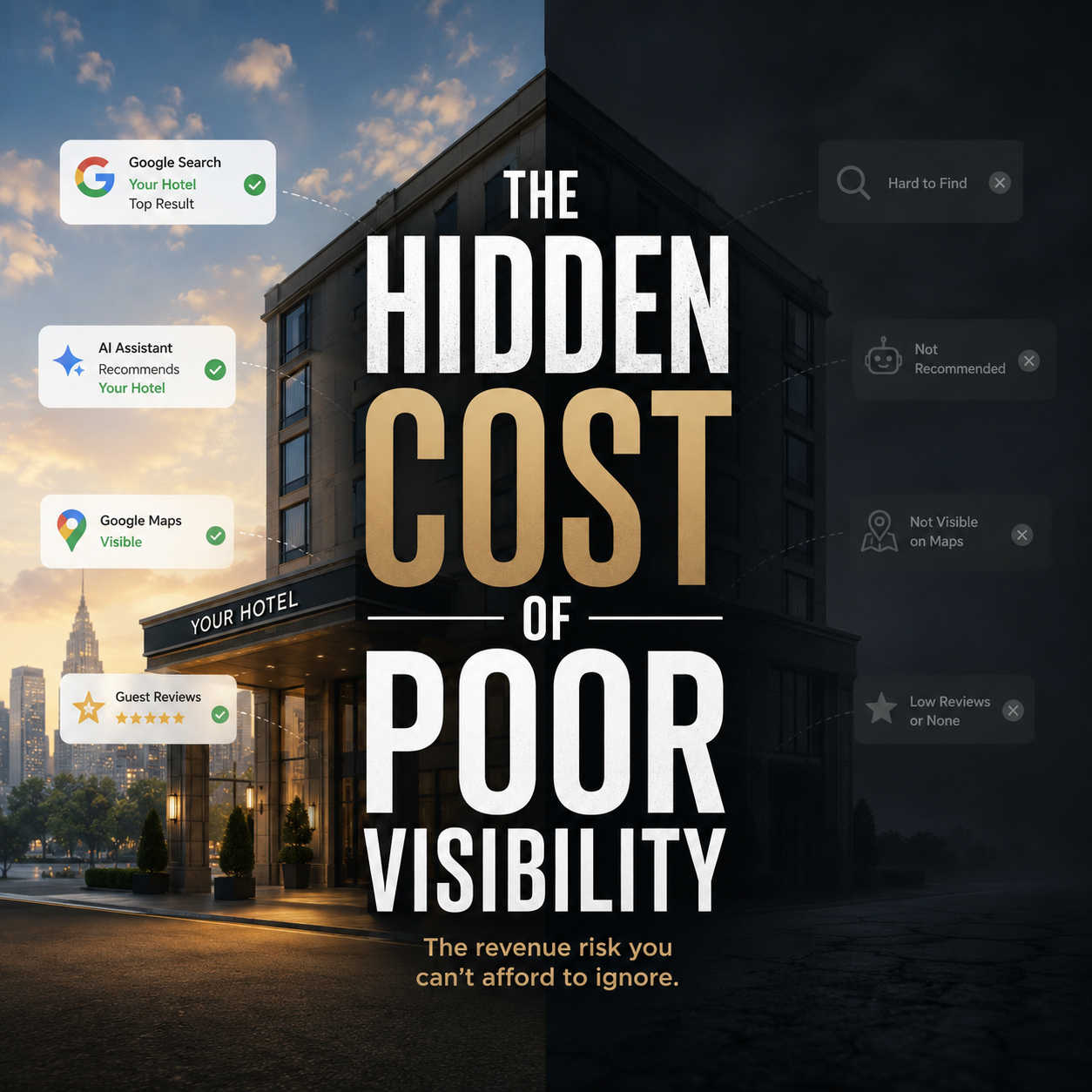
Imagine two comparable hotels. They offer similar rooms, similar amenities, comparable service, and are located in the same market. One consistently appears when travelers search Google, ask AI assistants for recommendations, browse maps, or compare hotels. The other doesn’t.
The second hotel isn’t necessarily inferior. It’s simply less likely to be considered.
The booking is lost long before a guest reaches the website. No reservation is cancelled. No complaint is filed. No report identifies the missed opportunity. The guest simply books somewhere else.
Unlike an equipment failure or a cybersecurity breach, invisible demand leaves almost no evidence behind. It becomes revenue that never had the opportunity to exist.
Every business has controls
Successful organizations don’t eliminate uncertainty, they build systems to manage it. Across every business function, controls exist to reduce risk and improve decision-making.
Consider just a few examples:
- Finance uses internal controls to reduce financial exposure.
- Operations relies on standardized processes to improve consistency.
- Cybersecurity continuously monitors for emerging threats.
- Revenue management measures demand to optimize pricing and occupancy.
Each discipline recognizes the same principle: uncertainty becomes significantly less dangerous once it can be measured.
Marketing should be viewed through the same lens.
Visibility is one of the controls that determines whether potential customers ever enter the buying process. When that control weakens, demand begins to decline long before traditional performance metrics have a chance to react.
Consumer behavior has fundamentally changed
Not long ago, the customer journey was relatively straightforward. Travelers searched Google, clicked through to hotel websites or OTAs, compared a handful of options, and made a booking.
Today’s journey looks very different.
A traveler may:
- Ask an AI assistant for recommendations.
- Browse Google Maps.
- Read reviews across multiple platforms.
- Compare properties before ever visiting a hotel website.
- Build a shortlist long before making a reservation.
By the time a guest reaches a booking engine, many of the decisions have already been made.
This creates a new challenge for owners and operators. Visibility is no longer created by a single marketing channel. It is the combined result of search, AI, maps, directories, reviews, and digital presence across an increasingly fragmented ecosystem.
Every change in consumer behavior introduces another layer of uncertainty. Ignoring those changes doesn’t remove the risk—it simply makes it impossible to quantify.
What cannot be measured cannot be managed
Enterprise risk management is built on a simple idea: organizations cannot effectively manage exposure they cannot see.
Hospitality has embraced this philosophy for decades. Occupancy, ADR, RevPAR, market penetration, and guest satisfaction have become industry standards because they provide a consistent way to measure performance and guide decision-making.
However, these metrics all have one thing in common.
They measure what happens after a traveler has already considered your property.
Very few metrics measure whether your hotel entered the consideration set in the first place.
That is the hidden gap.
Visibility is becoming a business metric
Digital visibility should no longer be viewed solely as a marketing KPI. It is increasingly becoming a business performance indicator that matters across the organization.
For different stakeholders, visibility answers different questions:
- Owners want to understand whether their asset is maximizing its revenue potential.
- Operators need to know whether local execution is creating demand.
- Brands need to measure their presence across competitive markets.
- Investors benefit from another indicator of an asset’s long-term competitive position.
As AI search and digital discovery continue to reshape how travel decisions are made, visibility is becoming a leading indicator of future performance rather than a by-product of marketing activity.
Measuring uncertainty
No hotel can control Google’s next algorithm update.
No operator can predict how AI assistants will evolve.
No owner can determine how travelers will search next year.
What organizations can control is whether they measure the impact of those changes.
Measurement transforms uncertainty into something that can be monitored. Monitoring enables informed decisions. Better decisions reduce risk.
That’s why visibility deserves to be measured—not simply as a marketing metric, but as a business metric.
Because some of the most expensive risks never appear on a financial statement.
They simply reduce revenue, one unseen customer at a time.
******
Learn more about DMscore here.
Set up an introduction call with us here.