
What James Cree’s The LookAhead series tells us about the changing hotel discovery journey, and why measurement needs to change with it.
We’ve been thoroughly enjoying James Cree’s The LookAhead series. Over the past several months, Jim has explored AI discovery, attribution, reputation, automation and the increasingly complicated relationship between technology and commercial decision-making in hospitality.
Read individually, each article tackles a different pressure point. Read together, they point to something more structural.
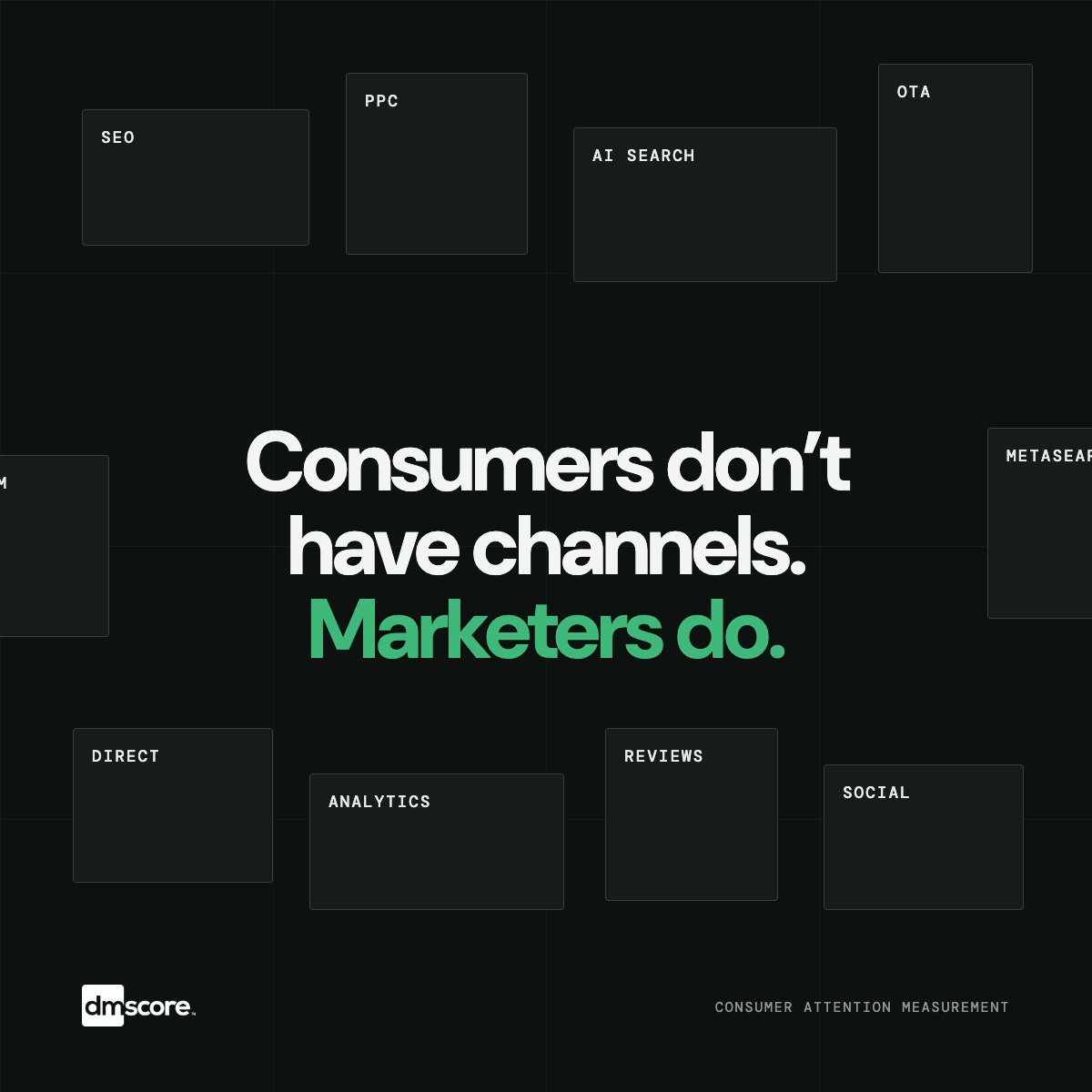
Consumers don’t have channels. Marketers do.
A traveler doesn’t consciously move through an SEO stage, then a paid search stage, then an AI Search stage. They have a need, ask questions, discover options, compare them, dismiss some, investigate others and eventually make a decision.
We’re the ones who divide the journey into channels.
For years, that worked reasonably well because digital discovery was more predictable and the platforms shaping it were easier to isolate. Now discovery is spreading across search engines, AI platforms, OTAs, review sites, social content and direct channels, while our measurement systems remain largely organized around the platforms themselves.
The problem isn’t a lack of data.
It’s that we’ve built measurement around channels rather than around how consumers actually make decisions.
Search is becoming selection
Traditional search trained marketers to think about position. Where do we rank? Are we above the competitor down the road? Are we appearing on page one?
AI changes the question.
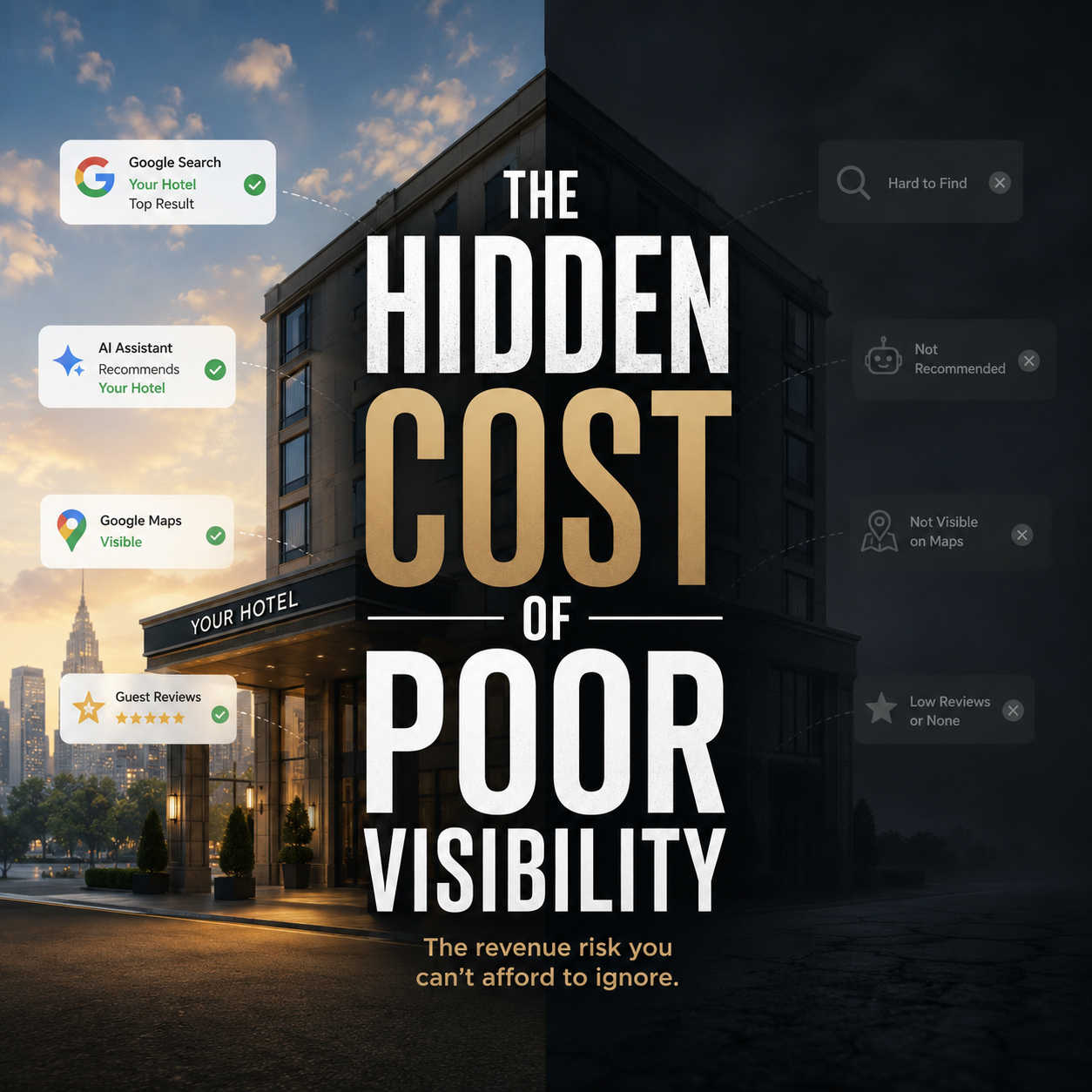
Skift’s State of Travel 2026 found 62% of global travelers are familiar with AI trip-planning tools, while only 6% of hotels currently surface in AI search results. Skift describes the behavioral shift as moving from “search-scroll-compare” towards “ask-shortlist-decide.” (newsletters.skift.com)
That’s more than a change in interface.
Traditional search tends to present options. AI increasingly selects them.
Jim makes this point well in a recent LookAhead, describing how a hotel can perform strongly in traditional Google search and effectively disappear when the same discovery question moves into an AI environment.
The hotel hasn’t changed. Its website still exists. Its SEO performance may remain strong. But from the consumer’s perspective, it simply hasn’t entered the consideration set.
The commercial risk is no longer always a competitor ranking above you.
It may be that you’re not in the answer at all.
Influence is happening before the transaction
The temptation is to judge AI by the wrong metric: whether people are booking through it.
Most still aren’t.
Expedia Group surveyed more than 5,700 adults across the US, UK and India in 2026 and found a clear gap between discovery and transaction. Fifty-three percent were comfortable with AI suggesting travel options, and 48% said AI helps them discover places they otherwise might not have found. At the same time, 66% said they wouldn’t trust an AI assistant to buy or book something on their behalf, while only 8% were comfortable booking through an AI platform. (ir.expediagroup.com)
The obvious conclusion is AI booking remains limited.
The more important conclusion is AI doesn’t need to own the transaction to influence it.
It can introduce a hotel, remove one from consideration, compare several properties or shape the initial shortlist before the traveler visits a hotel website.
This matters because it exposes a weakness in how we traditionally measure marketing performance.
Visibility precedes traffic. Discovery precedes conversion.
By the time someone reaches your website, part of the decision may already have been made.
Attribution starts too late
Jim explores this in The Booking Arrives. The Attribution Doesn’t.
Imagine the journey. A traveler asks ChatGPT where to stay, Googles two of the recommendations, reads Tripadvisor, opens Booking.com, returns to Google, clicks a paid result and eventually books direct.
The reservation arrives.
Analytics will assign credit somewhere. The direct visit may receive the conversion. Paid search may get partial attribution. Another model may distribute credit across several known touchpoints.
But the interaction which created initial consideration may never appear in the model at all.
This is where attention and attribution separate.
Attribution asks which measurable interaction deserves credit for an outcome.
Attention asks something earlier: were you visible while the consumer was still deciding?
They’re both useful questions, but they’re not interchangeable.
Hospitality has become very good at measuring what happens once someone enters a measurable funnel. We’re much less sophisticated at understanding who was capturing attention before the funnel began.
AI exposes the limits of channel-level measurement
Jim’s Your Hotel Has Two Reputations. You Only Know One makes this problem even clearer.
The version of a hotel understood by AI isn’t necessarily the version carefully constructed by its marketing team. AI can draw from Tripadvisor, Reddit, Quora, local press, blogs, restaurant reviews, forums and content published long before the property’s current positioning existed.
As Jim puts it, “The score is the surface.” (linkedin.com)
A hotel may renovate, reposition and completely rebuild its brand identity while the wider digital record continues to tell a different story.
This matters beyond reputation.
If AI is synthesizing signals across environments the hotel doesn’t control, measuring performance one channel at a time becomes even less complete.
SEO can tell you how you perform in search.
Paid media can tell you how you perform in paid placements.
Web analytics can tell you what happens once someone arrives.
None of those, independently, tells you whether your brand is consistently present across the environments shaping the consumer’s decision.
That’s the gap.
Hospitality has plenty of metrics. What it lacks is a unifying view.
Hotel commercial teams already operate across SEO platforms, paid media dashboards, web analytics, PMS data, CRM systems, revenue management systems, OTA reporting, STR, reputation platforms and increasingly AI tools.
The issue isn’t data scarcity.
It’s fragmentation.
The State of Distribution 2026, produced by RateGain with NYU SPS and HEDNA and based on more than 270 hotel brands representing over 58,000 properties, found more than 80% of hotel commercial teams still spend one to two days every week producing and analyzing reports manually. Fewer than 30% have invested in dedicated reporting tools, and although more than half of hotels are using or procuring generative AI, fewer than one in ten report reductions in manual work of more than 30%. (rategain.com)
More technology hasn’t automatically created more clarity.
In some cases, it’s simply created another system measuring another part of the same journey.
This is where Jim’s broader point becomes particularly relevant. The guest increasingly experiences the hotel as one connected decision, while the business behind the experience remains divided across teams, systems and reporting structures.
A hotel can know its SEO rankings, paid impression share, website traffic, OTA contribution, AI mentions, bookings and RevPAR and still struggle to answer a much simpler question:
How visible are we, overall, compared with the hotels competing for the same consumer?
The measurement architecture needs to change
At DMscore, this is the problem we’re trying to solve through Consumer Attention Measurement.
Online Share of Attention measures competitive visibility across SEO, PPC and AI Search to create a view above the individual channels.
Not because channel metrics are wrong. They’re valuable because they measure specific environments well. But they’re pieces and the consumer experiences the whole!
A traveler might discover one hotel in Google, another through AI Search, repeatedly see a third through paid search, recognize a fourth from an OTA and eventually book whichever property has become most salient during the decision.
Each platform can report what happened inside its own environment.
None can independently answer the bigger question:
Who was consistently capturing the consumer’s attention?
That’s the question we believe hospitality needs to get better at answering.
We built measurement around platforms, not people
Most digital measurement reflects the architecture of the technology marketers use.
Google gave us search metrics. Advertising platforms gave us impression and click metrics. OTAs gave us distribution metrics. Analytics platforms gave us website metrics.
Each system measures what it can see.
The problem is consumers have never behaved according to this architecture. We’ve become very good at treating the pieces as though they represented the whole.
AI makes this harder to ignore because it can absorb information across environments, synthesize it, remove options, recommend others and influence decisions without producing the neat trail of measurable interactions marketers have spent decades learning how to attribute.
This doesn’t make traditional metrics less useful. It just makes the gaps between them more important.
The next evolution in hotel measurement may not be another AI-specific dashboard or another channel-specific KPI. It may be learning to measure something more fundamental: the consumer’s available attention across the places where discovery actually happens.
Consumers don’t have SEO strategies, PPC strategies or AI Search strategies >>> They have questions, preferences and choices.
… And our measurement should reflect that!
This is what we’ve found so compelling about James Cree’s The LookAhead. Across AI discovery, attribution, reputation and organizational decision-making, Jim keeps surfacing different symptoms of the same structural shift.
The consumer journey is becoming harder to contain inside individual channels.
The question for hospitality isn’t whether we need more data.
It’s whether the way we’ve organized measurement still reflects how consumers actually make decisions.
If the consumer never experienced the journey as separate channels, why are we still measuring it as if they did?
Thanks to James Cree for continually giving the hospitality industry something worth thinking about in The LookAhead.